
Quickstart
CoSApp Overview
CoSApp is a multidisciplinary oriented tool for the simulation of systems. Its goal is to provide a user-friendly and efficient environnement to build, exchange and solve physical models.
Get started
Import core python package
[1]:
# import cosapp base classes
from cosapp.base import System, Port
Create a simple system
from scratch (for more information, see tutorials)
[2]:
class XPort(Port):
    def setup(self):
        self.add_variable('x', 1.0)

class Multiply(System):

    def setup(self):
        """Defines system structure"""
        self.add_inward('K1', 5.0)      # define a new data variable
        self.add_input(XPort, 'p_in')   # define a new input port
        self.add_output(XPort, 'p_out') # define a new output port

    def compute(self):
        """Defines what the system does"""
        self.p_out.x = self.p_in.x * self.K1

s1 = Multiply('mult') # instanciate the class, it *creates* a new object with those properties
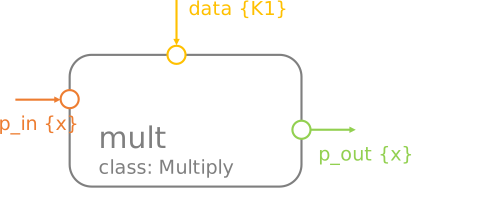
reuse an existing
Systemfrom a library (here the default cosapp unit test library)
[3]:
from cosapp.tests.library.systems import Multiply1
s2 = Multiply1('mult')
Run it!
change inputs or data if necessary
[4]:
s1.p_in.x = 10.
s2.p_in.x = 15.
make a simple run of your model
[5]:
s1.run_once()
s2.run_once()
have a look at your inputs, inwards and outputs
[6]:
print(s1.p_in, s2.p_in)
print(s1.inwards, s2.inwards)
print(s1.p_out, s2.p_out)
XPort: {'x': 10.0} XPort: {'x': 15.0}
ExtensiblePort: {'K1': 5.0} ExtensiblePort: {'K1': 5.0}
XPort: {'x': 50.0} XPort: {'x': 75.0}
Congrats! You’ve run your first CoSApp model!